It May Snow Again in the Rio Grande
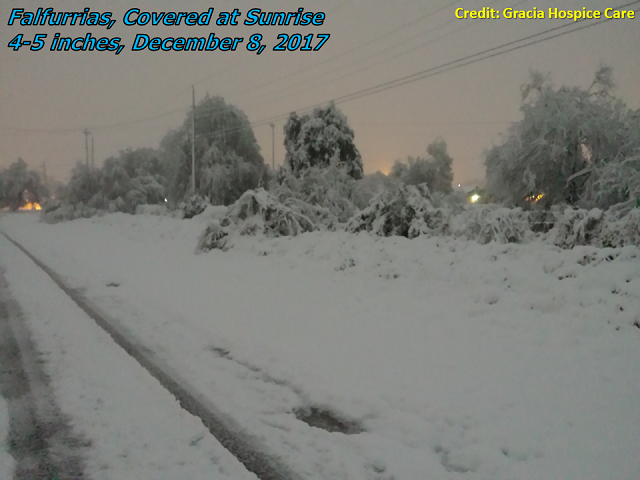
Photos from across the Rio Grande Valley during and after the historic snowfall of Dec 8, 2017. Credits: NWS Brownsville/Rio Grande Valley, Rio Grande Urban center Fire, Edinburg Fire, Harlingen CISD, U.s. Edge Patrol, Gracia Hospice Intendance of Falfurrias, Texas Commission on Environmental Quality, Texas Section of Land Health Services.
Earliest Widespread Measurable Snow on Record Brings Out Christmas Spirit
Report
It was a day for children, and for children of all ages to tell their children and grandchildren about!
For the first time since the wondrous White Christmas of 2004, the entire Rio Grande Valley awoke to wintertime weather at or presently subsequently daybreak on December 8th. The winter weather was even more stunning, in light of what had been a record–warm 2017, a top–v (for about) warmest autumn (September–November), and tardily summerlike conditions hanging on for the first five days of December where even the beaches of S Padre Island were an advisable place to relax, out or in the still warm (75°F) surf. On December 6th, "summertime" was rudely erased past the get-go large cold front end of the season. Afternoon temperatures betwixt the 5th and 6th crashed more than 35°F, from the balmy mid 80s to the spooky upper 40s. Combined with gusty northwest winds, it felt colder withal (upper 30s to lower 40s). As high pressure with roots in northwest Canada connected to push to the edge of the western Gulf torrid zone on the 7th, temperatures continued to fall, dipping to the mid to upper 30s across the Rio Grande Plains and low to mid 40s across the Valley during the day Thursday. Feels similar temperatures brutal into the upper 20s to mid 30s, as stiff n winds combined with occasional low-cal pelting or drizzle from somewhat warmer and more humid air overrunning the cold surface air to add more misery to the biting chill that followed so many warm and humid days to stop November and start December.
Overnight on the 7th, and continuing into the 8th, an embedded upper level disturbance descended the back side of a growing upper level trough that would before long stretch across the entire eastern 2–thirds of the nation. The disturbance provided several critical pieces of the atmospheric puzzle (see Pattern Matters section) that would change miserable biting pelting into a snowscape that brought impromptu celebrations of the flavor on a Friday, less than iii weeks before Christmas. Low-cal rain mixed with sleet and snow before changing to all snow, from northwest to southeast, on the eighth. The initial changeover occurred across the Rio Grande Plains of Jim Hogg and Zapata County between midnight and 2 AM, and would quickly scoot through the remaining ranch country before 4 AM, and reach much of the populated Valley before 6 AM. Because the low levels of the atmosphere were marginally conducive to snow, the highest accumulations were seen in stronger bands that fell before sunrise at the slighly higher elevation of the ranchlands (see radar loop, below), which allowed temperatures to fall to 32 or 33°F for the elapsing of the band. In locations where the bands tapered off, or where bands were less intense, snow accumulation was limited and often the snowfall would become mixed with rain once more. Highest accumulation, ranging from three to nearly half dozen inches, fell in a stripe from southwest Zapata County through northwest and northern Starr, southern Jim Hogg, and western Brooks County, extending northeast to areas west of Kingsville and ultimately to the Corpus Christi metro area, where 4 to 6 inches piled up before daybreak. Multiple bands developed or re–developed betwixt 5 AM and noon, with additional snow for the same stripe from Zapata through Brooks but also sliding into the more populated Rio Grande Valley, mainly forth and north of Interstate 2. Much of these bands fell after daybreak, which allowed low–latitude daylight to counter the moderate snow and hold accumulation down to around an inch. The final band exited southeast Cameron Canton (Brownsville to South Padre Island) soon after noon.
The heavy, wet snow clung to trees, buildings, fences, windmills, etc. across the S Texas Brush Country, for a rare scene of beauty that could exist a once or twice in a lifetime scene. In Falfurrias, snowfall rates reached one to two inches per hour and coated even paved roads with 1 to ii inches (at least) of white, which closed a number of roads for a time during the morning of the 8th in and near Falfurrias. There were also some vehicle incidents in areas where slush or snowfall impacted roads, including around Falfurrias, along US 77 in northern Kenedy County, and along US 83 north of Zapata (where a schoolhouse charabanc was hit by another vehicle that slid on an elevated bridge). For many others, still, the snow was a wonder to behold; children took time out to build pocket-sized snowmen and gustatory modality the rare snow flakes from above during school breaks. Sunshine returned to the Mid and Upper Valley/Rio Grande Plains by mid afternoon, with temperatures rising into the lower 50s. Roads apace dried up, though the snow pack from Zapata through Brooks County remained into early Saturday, and north–facing roofs, vehicles, etc. in the Lower Valley yet had a dusting through noon on Saturday, December 9.
While it may non technically accept been a "Christmas" snow, for the Rio Grande Valley, information technology was the next best thing.
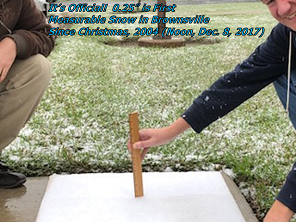
It's Official! For the first time since Dec 25, 2004, measurable snow occurred at Brownsville/South Padre Island International Airport, measured at noon, December 8, 2017
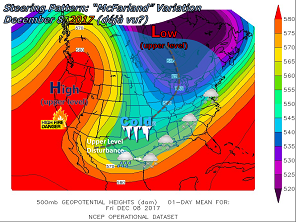
500 mb (~18,000 anxiety) steering pattern, and the general weather state of affairs, for Dec viii, 2017
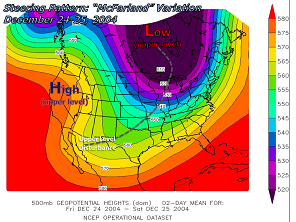
500 mb (~18,000 feet) steering blueprint for Dec 24/25, 2004. Can you see the similarity?
Pattern Matters
A few days before the inflow of the December 2017 Winter Wonderland, computer model forecasts were beginning to latch onto a pattern that provided the possibility for winter weather all the way to the Rio Grande Valley and northern Mexico. Initially, confidence was highest for a somewhat prolonged period of common cold weather with light pelting on the sixth and seventh only clearing by the 8th, followed past relatively warmer weather condition though closer to early December averages (afternoons in the depression to mid 70s, mornings in the lower 50s) as for the first fourth dimension since early on 2017, air from the arctic (due north of 66.half dozen° North Breadth) would be tapped. On December quaternary, the forecast blueprint for 6 AM Friday, Dec 8th, was compared with the observed design for half-dozen PM Dec 24, 2004; the similarity was hitting. One critical departure early on was the force of the low level cold air for this effect, which was marginal for meaning snow accumulation. That said, the December eighth event was expected to occur during the midnight to 9 AM time frame, perfect for snow to accrue even at marginal temperatures. The pattern in each case is a variation on the McFarland Pattern, known to produce a range of freeze possibilities for the (Lower) Rio Grande Valley of Texas. On December viii, 2017, similar to the White Christmas 2004 effect, an upper level disturbance rounded the developing trough and provided the necessary atmospheric lift to produce several precipitation bands. These bands began as rain well ahead of the disturbance Th afternoon and evening, but as the atmosphere cooled with the approach of the disturbance, rain changed to snow from "top to lesser" beginning during the late evening near Laredo and connected eastward, reaching the Upper Valley/Rio Grande Plains of Deep South Texas effectually midnight, and the Lower Valley to the King Ranch toward daybreak. Much of the snow fell at the freezing indicate (32°F) or 33°F but was able to accumulate with rates that approached i to 2 inches per hour in the most pronounced ring from Zapata through Brooks Canton on into Corpus.
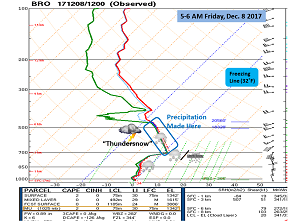
Atmospheric sounding (contour) from half dozen AM, Dec viii, 2017, in Brownsville. As the temper cooled from elevation to lesser, precipitation changed to snow. At the fourth dimension of this images, sleet was falling in Brownsville – a effect of the last warm layer at roughly 9,000 feet above ground. That warm layer would be erased soon later on, and Brownsville saw several hours of light snow. In the snow production zone, instability was sufficient to produce "thunder snow", an event more familiar to due east coast storms than the Rio Grande Valley. Thunder snow was besides reported late at nighttime near Corpus during heavier bands at that place.
Almost forgotten amidst the snowfall was the bone chilling cold and Gulf Gale. The same upper level pattern (higher up) that supported snow helped develop a western Gulf Gale, again an event more than common to the east coast Nor'easters than the southern tip of Texas. The Gale churned up 11 to xv feet of rollicking seas (Beaufort Calibration 7) with frequent winds of 34 knots or greater, and cranked upward northwest winds due east of Us 77/Interstate 69E to over 20 mph overnight through early Friday morning. Wind chill temperatures plummeted into the 20s across Deep South Texas and the Valley, with everyman values on Due south Padre Island (20°). Afterward Fri and Fri night, the unabridged disturbance plowed eastward and led to the flavour'due south first snowfall event from Louisiana through northern Mississippi, Alabama, and Georgia, the western Carolinas, and the mid Atlantic and New England states. Sunny skies and moderating temperatures melted all snow on the 9th, and 70 degree weather returned by December 10th.
Quick Stats
- This was the primeval known Valley–wide measurable snow on record. The prior earliest Valley–wide snow was the White Christmas in 2004.
- For Brownsville, this was only the second known measurable snowfall since 1895, though at that place may take been measurable snow that was not accounted for by observers in the 20th century. These cases volition be reconciled in the well-nigh future.
Other notable snow events that affected many or parts of the Valley and Ranch areas*:
- January 9 to ten, 1967
- January 21 to 23, 1940
- Jan 23 to 24, 1926
- February 6 and seven, 1906
- February xiii to xiv, 1895†
- Dec 31, 1880†
- January ane to iii, 1867†
*Dates are spanned in nearly cases due to climate information beingness recorded from seven AM to vii AM, not midnight to midnight.
†Unknown how far west into the Rio Grande Valley or ranchlands these particular events stretched; data were not available for sites well inland.
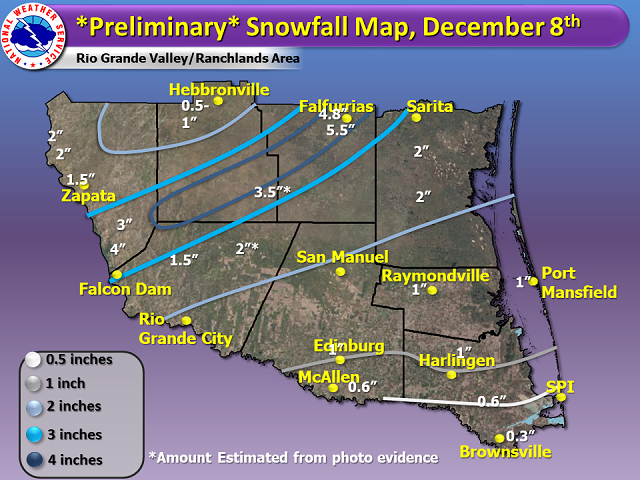
Preliminary snowfall map for Dec 8, 2017. Information from a mix of spotters, public safe officials, Collaborative Rain Hail and Snow Network (CoCoRaHS), trusted social media photographs, and the National Operational Hydrologic Remote Sensing Center. This map will exist updated.

Radar loop of base reflectivity at 0.5° peak, from around xi PM CST on December vii to one PM CST Dec 8th.
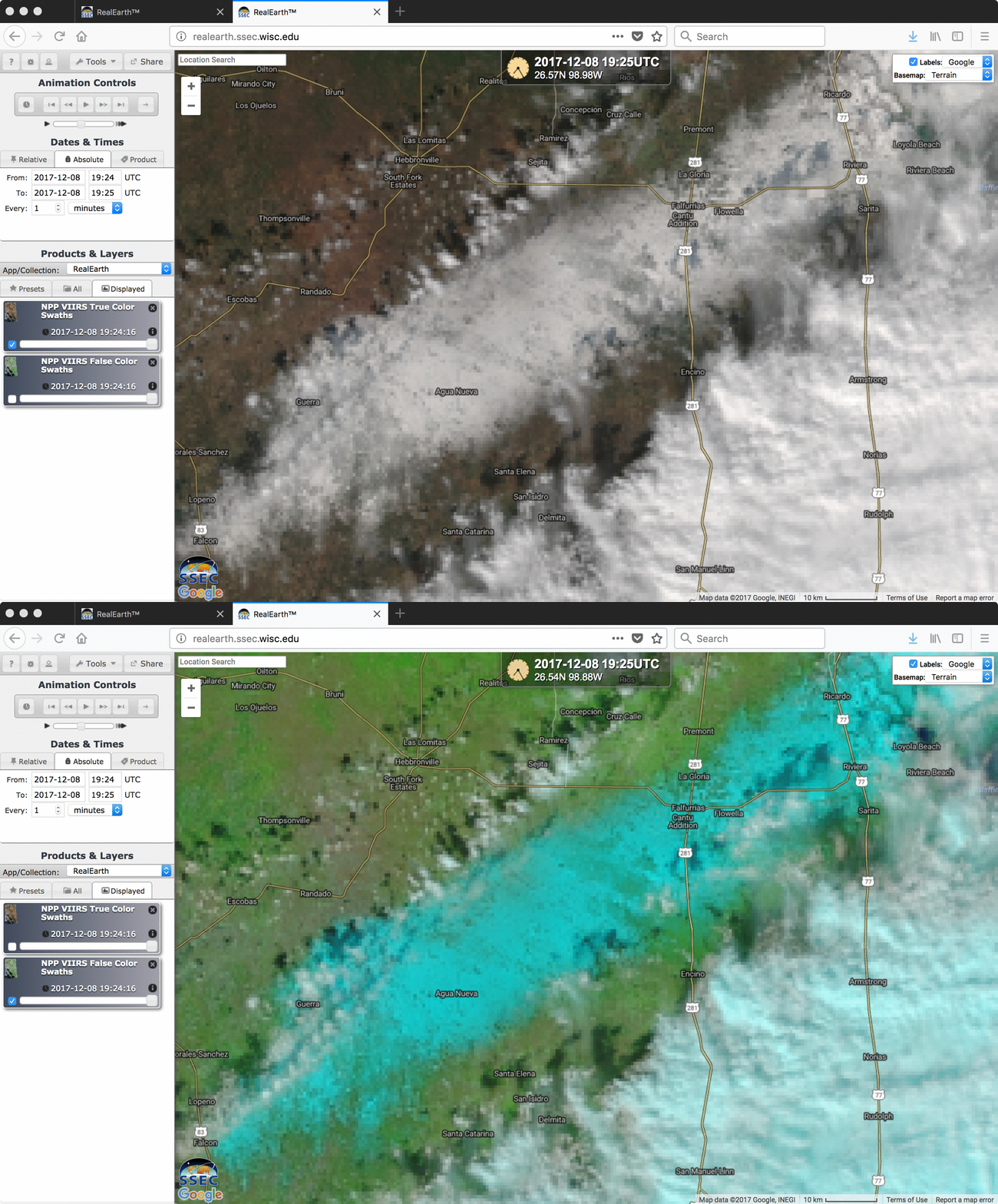
True and Fake color satellite photograph of the stripe of heaviest snowfall from Zapata County through northern Starr, southern Jim Hogg, and western Brooks into the Corpus Christi area shortly after clouds cleared on December 8th. Data courtesy of the Cooperative Institute for Meteorological Satellite Studies at the University of Wisconsin-Madison.
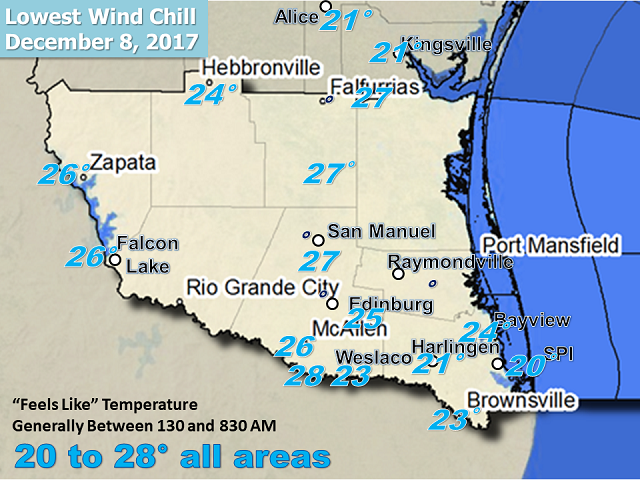
Minimum feels similar (wind chill) temperatures early on Dec 8, 2017, across the Rio Grande Valley and South Texas Brush State.
geislerforbeartne.blogspot.com
Source: https://www.weather.gov/bro/2017event_december8snow
0 Response to "It May Snow Again in the Rio Grande"
Post a Comment